
Digitalization in SMEs – why and how? – Part II
by Chris Ryan

Part 2 of the series:
Digitalization, data-driven business management, artificial intelligence, etc. Manufacturing SMEs are not only exposed to intense competition, but also to a flood of buzzwords. Our project experience in the SME environment shows that what is needed is not a big leap, but small, safe steps. Once a company-specific action plan has been defined, the OT-IT gap can be overcome by connecting production and ERP.
Removing data silos with a new architecture
In order to benefit from digitalization through process optimizations, cost reductions, etc., there is no way around data. In many manufacturing SMEs, data from operational technology (OT, e.g. PLCs or sensors) and information technology (IT, e.g. ERP or CRM) are not connected for various reasons:
- Technology: Firewalls, network boundaries etc. separate the systems from each other.
- Costs: A 1:1 connection of all OT or IT systems can quickly become complex and expensive.
- Organization: Employees with different specialist knowledge are usually responsible for the various systems.
Modern data architecture approaches such as the unified namespace concept pave new ways of leaving the OT-IT divide behind. The software bridge between the production hall and ERP developed by iosys for maxon serves as an illustrative example of how this can be achieved.
Business systemsERP/ MESServicesSecurity APIoptionalRuns on DaprERP BridgeRuns on DaprOther apps/ servicesRuns on DaprClientsClient (PLC)Client (Tablet)On EdgeMQTT BrokerIn CloudoptionalMQTT BrokerEvent Hub, Databricks, etc.Microsoft AzureConnectionsERP/ MES Security API (Service invocation (REST))Security API ERP Bridge (Service invocation (REST))ERP Bridge MQTT Broker (Pub/ Sub)Client (PLC) MQTT BrokerClient (Tablet) MQTT Broker (Pub/ Sub)Other apps/ services MQTT BrokerMQTT Broker In Cloud Microsoft AzureoptionalMQTT Broker Event Hub, Databricks, etc.
Example of a software bridge between the production hall and ERP to overcome the OT-IT gap. Instead of point-to-point connections, the systems publish ("pub") and subscribe (sub) data to and from a unified namespace that uses the MQTT protocol. As the success story shows in more detail, maxon saves a lot of time and money thanks to this iosys development.
Contrary to what is often expected, the implementation of the SW bridge does not usually require a costly upgrade of the production hall. This is because sensors or control technology (e.g. via PLC) are often already available – or can be installed as part of a retrofit at a manageable cost. In-house developments instead of "large" standard solutions, such as the ERP bridge shown above, make the architecture even leaner and more flexible for further developments.
Transparent production through meaningful data
If data is connected using intelligent architecture, it can be used to generate new insights, improvements and ultimately profits. Examples include the automatic calculation of machine utilization, the adjustment of shift schedules, or the optimization of raw material purchasing. The establishment of such "transparent production" requires functioning data evaluation, which in turn requires data expertise.
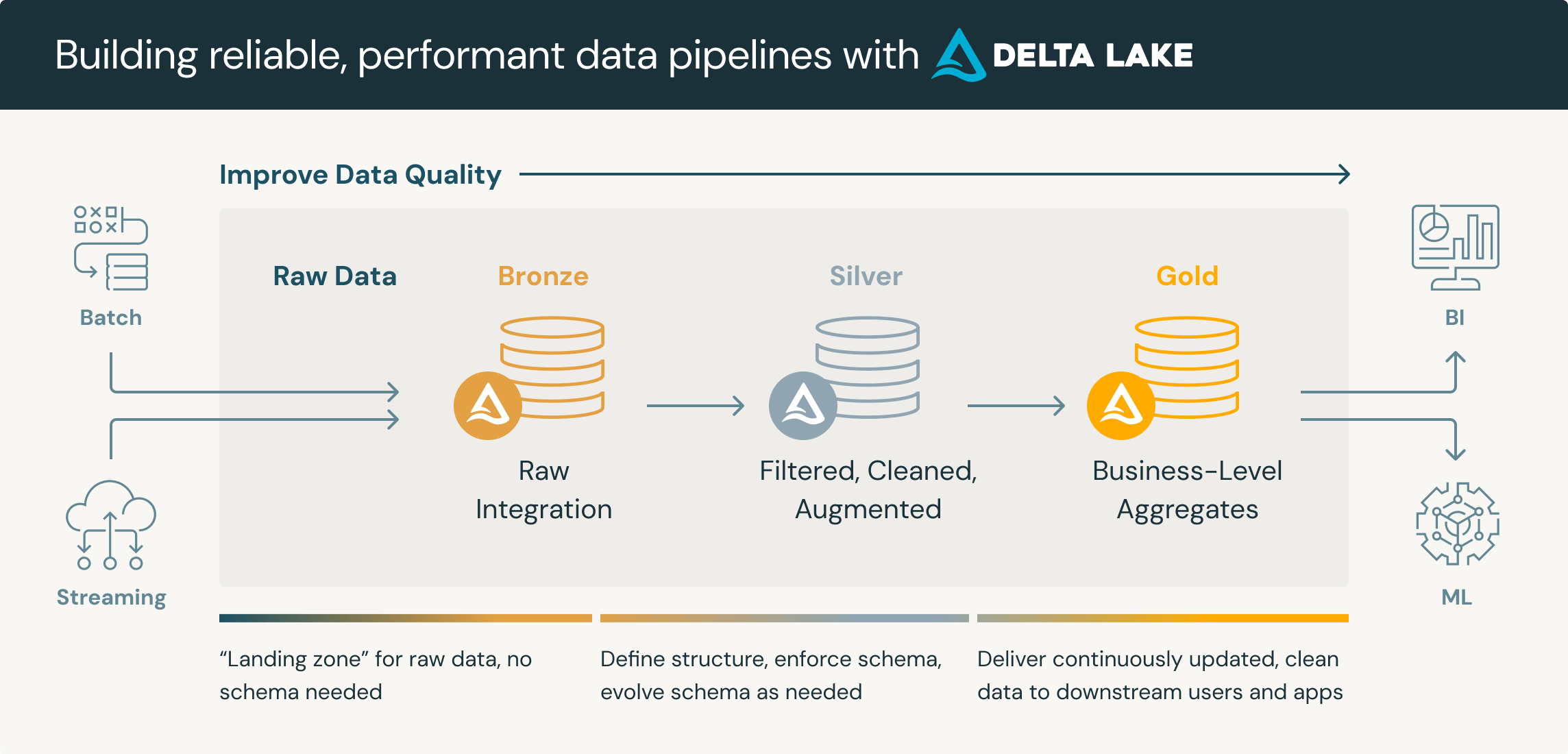
Along the so-called Medallion Architecture, the data fed into Databricks passes through various layers. The data fed into Databricks passes through various layers and forms a possible basis for applications in the field of business intelligence (BI) or machine learning (ML).
For the storage, processing, and visualization of data from various sources, the data platform Databricks (see illustration) has proven to be a powerful tool in various iosys projects. In our experience, data visualizations in particular are useful for internal and external communication. This is especially true when it comes to convincing your own employees of a new solution.
The consistent integration and utilization of relational and unstructured data ("data lake") are key milestones on the path to a transparent company. In addition to optimizing organization, processes and KPIs, a solid database also forms the foundation for in-house AI applications and other purposes.
In the third article of the series, you can find out more about how companies can make the transition from a transparent to a self-regulating organization.
iosys: An SME for SMEs
Implementing digitalization projects requires the right combination of skills. Our SME customers often already have a great deal of knowledge in certain areas. Since we are an SME ourselves, we have the flexibility to complement them with our versatile expertise and industry experience. Where we really deliver added value.
What are your goals? We would be happy to discuss with you whether and how we can make your production processes more transparent and effective. We look forward to hearing from you.