
Ask Your Machines: Natural Language Access for Your Factory Data
by Chris Ryan
Factories generate enormous volumes of data every day, yet most teams struggle to access it when they need it most. Natural language interfaces are changing this by translating questions directly into database queries. Using iosys' two-loop learning architecture, built on an open source framework with modern language models, the system learns from your data, improves with every interaction, and ensures safe operation. The result: your factory becomes faster, more transparent, and genuinely data-driven.
Key Takeaways
-
Data exists, but access does not. Machine operators see anomalies but cannot query the database directly.
-
Natural language removes the SQL barrier. Ask questions in plain language and receive charts, tables, or single values.
-
Two-loop architecture enables continuous learning. Offline bootstrapping seeds the system; online learning improves it daily.
-
Safe by design. All queries are read-only, validated, and auditable.
-
Realistic ROI. A typical SME can save over 50 hours per month on data requests.
The 5:47 AM Problem: Data Exists, Access Doesn't
Picture this: a shift supervisor notices something unusual on a machine during the night shift. The data they need sits in a database, just a few tables away. But they can't reach it.
What happens next is all too familiar. They submit an IT ticket, wait a few days, receive a static PDF report, then send yet another follow-up request because the PDF didn't quite answer their question.
This pattern slows reaction time and prevents shop floor staff from resolving issues quickly. The frustrating truth? The problem isn't missing data, it's missing access.
Why SQL Keeps the Shop Floor Waiting
SQL (Structured Query Language), a programming language for querying databases, is powerful, but it demands expertise. Even seemingly simple questions require knowledge of joins, window functions, and time filters. Most machine operators can't write SQL, and shouldn't have to. Meanwhile, analysts can't keep up with the endless stream of ad-hoc requests.
The result: a factory that runs on delayed reporting cycles, decisions made without data, and mounting frustration across teams.
Asking Questions the Way You Already Work
With natural language access, staff simply ask what they want to know:
- "What was the power consumption for the DMG yesterday?"
- "Which machine had the most errors today?"
- "Show hourly temperature trends."
- "How long were the milling machines in operation this month?"
talk.factoriq responds with exactly what's needed, whether that's a single value, a time-series chart, a ranked list, or a comparison table. The system understands your machines, your schema, and your terminology because it was trained specifically on your data.
How It Works: A Two-Loop Architecture With Continuous Learning
talk.factoriq uses a two-loop architecture built on an open source framework. The first loop handles the heavy analysis once during setup. The second loop runs fast and improves continuously through daily use.
Loop 1: Offline Bootstrapping (Before Go-Live)
This loop runs once using Claude Opus 4.5, Anthropic's most capable language model.
Claude Opus 4.5SQL tool (read-only)TimescaleDBAuto-discover schemaGenerate Q-SQL pairsVector DB
During bootstrapping, the system explores your database schema, discovers tables, metrics, and timestamps, generates over 100 question-SQL training pairs, and stores the relationships in a vector database that enables searching for similar questions.
This solves the cold start problem. Once the system goes live, it already understands your data structure and can answer questions from day one.
Example: Bootstrapping Output from a Real Factory
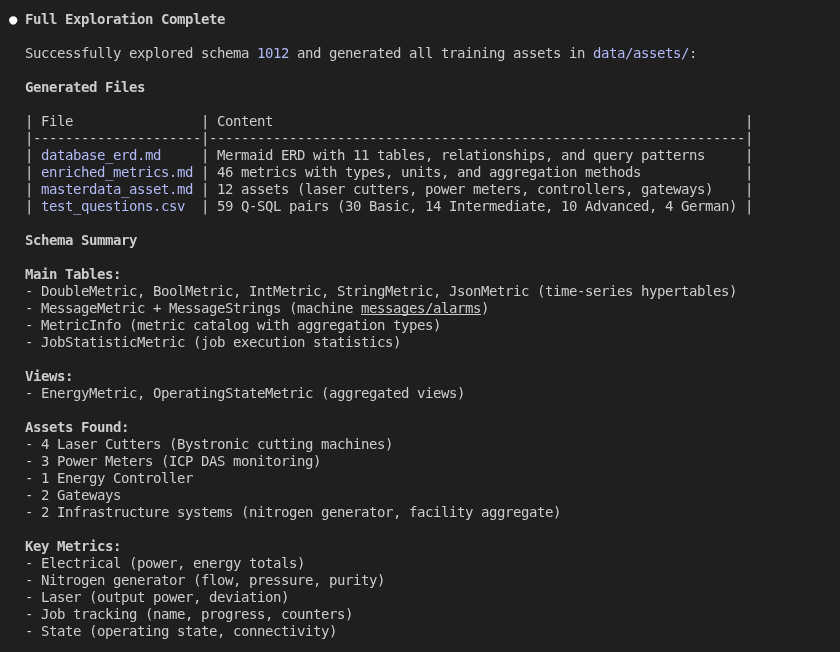
The image below shows the result of running Claude Opus 4.5 on a real telemetry database. In just minutes, the system discovered 11 tables, 46 metrics, 12 assets (laser cutters, power meters, controllers), and generated 59 question-SQL training pairs, already validated and ready for production use.
Loop 2: Online Learning (Daily Use)
Once live, the system runs continuously using a smaller, faster, and more cost-effective language model such as GPT-4.1-mini.
User QuestionGPT-4.1-mini (fast)RAG RetrievalTimescaleDBResultsStore success in Vector DBGPT-4.1-mini (fast) → Results
Example: Timeseries Assistant in Action
Here's a real query: "Can you do an analysis on the error count per unique message over the last week? Group by message and asset." The system retrieves similar examples from memory, generates SQL, executes it, and returns 215 rows of results, all in seconds.
Explorative data analysis in action: notice how the agent recovers gracefully from failed tool calls and continues toward the answer.
The Positive Feedback Loop
Every successful query makes the system smarter:
QuestionsGood SQLStored examplesBetter retrievalBetter SQLMore usage
The system becomes more accurate every day, learning how your team formulates questions.
What You Can Ask: Real Operational Use Cases
The agent handles the questions that matter most to manufacturing teams:
- Runtime vs. downtime analysis
- Scrap patterns by shift
- Energy anomaly detection
- Cycle time comparisons
- Error event grouping
These queries normally require advanced SQL knowledge. Now they require one sentence.
A Realistic SME ROI Example
Consider a factory with 25 machines that generates approximately 120 data requests per month. Let's do the math:
120 requests × 45 minutes = 54 hours per month
54 hours × 12 months = 648 hours per year
That's roughly 0.3 full-time equivalents spent just answering data questions. Natural language access cuts this by approximately 80%, saving over 50 hours per month that teams can redirect toward actual improvements and other value-adding activities.
The hidden costs run even deeper. When operators can't quickly pinpoint the root cause of an issue, problems escalate. A machine runs suboptimally for hours or days while waiting for data analysis. Scrap rates increase. Energy waste goes undetected. Maintenance windows get extended because nobody can confirm what actually happened. These downstream costs, often invisible in traditional accounting, can dwarf the direct time savings.
Deployment in Eight Hours
Getting started is faster than you might expect:
| Hours | Activities | Outcome |
|---|---|---|
| Hour 1–2 | Connect to database (read-only) | Secure integration |
| Hour 3–4 | Run offline bootstrapping with Opus 4.5 | Vector database seeded |
| Hour 5–6 | Deploy agent, onboard users | System is live |
| Hour 7–8 | Enable online loop, start learning | Continuous improvement |
Conclusion
Your machines already know the answers. With iosys, your team can finally access them in seconds.
The two-loop architecture, open source Vanna.ai engine, and safe SQL generation make this practical and accessible for manufacturing SMEs of any size. Where this category sits among the others, and what it needs to pay off, is set out in Which AI Tools Pay Off for Manufacturing SMEs?. How such a fact layer fits into a whole architecture is shown in The Model Comes Last.
Ready to give your team fast access to production data? Contact us to discuss your use case.